
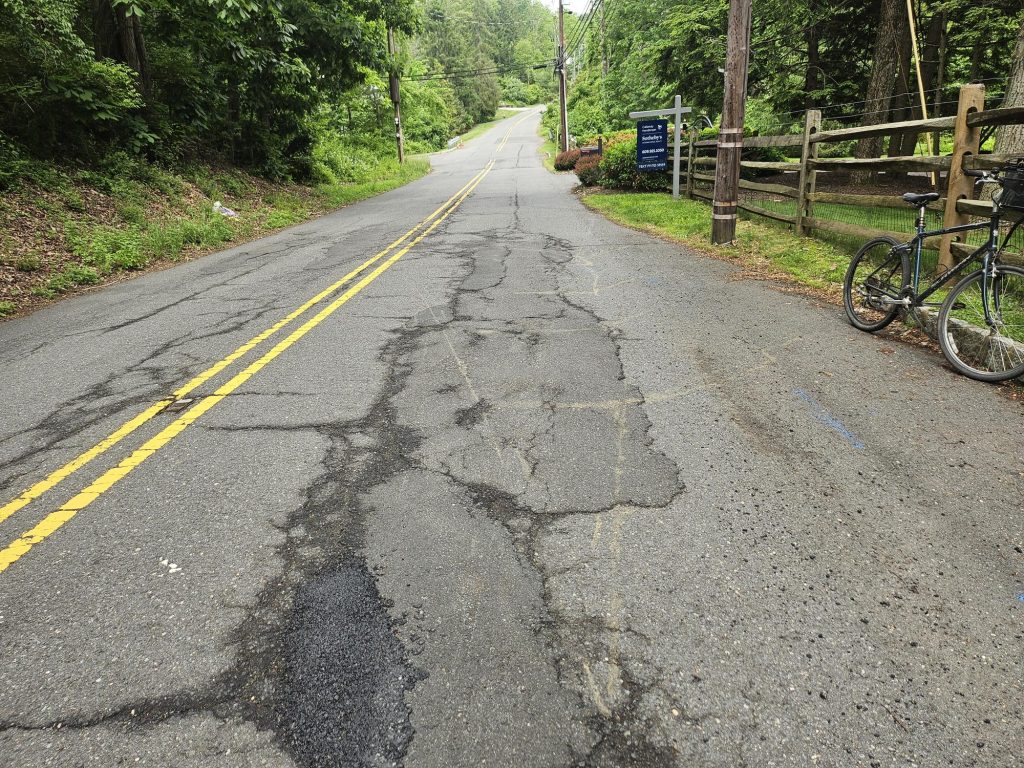
Last week a cyclist hit a pothole on Pretty Brook Rd, crashed and sustained multiple serious injuries. He was transported to hospital, but tragically passed several days later. It is a heartbreaking story that should have never occurred. I extend my deepest sympathies to his family and friends, as do the entirety of Walk Bike Princeton.
I’ve been a member of the Princeton Free Wheelers (PFW) bicycle club for over a year and received news of the incident via an email from them. As a cyclist, it can be an intimidating thing to head out onto the road in Princeton – dealing with the stresses of car traffic and distracted drivers is hard enough. I should know, as last August a driver turned without looking and struck me while I was riding in the bike lane on Washington Rd (wearing hi-visibility, bright yellow head to toe and with flashing lights front and back, I might add). There are inherent risks to riding a bike of course, but in a town that is wealthy, well-educated, and supposedly committed to “Vision Zero”, having to navigate municipal roads that look like the surface of the moon shouldn’t be one of them.
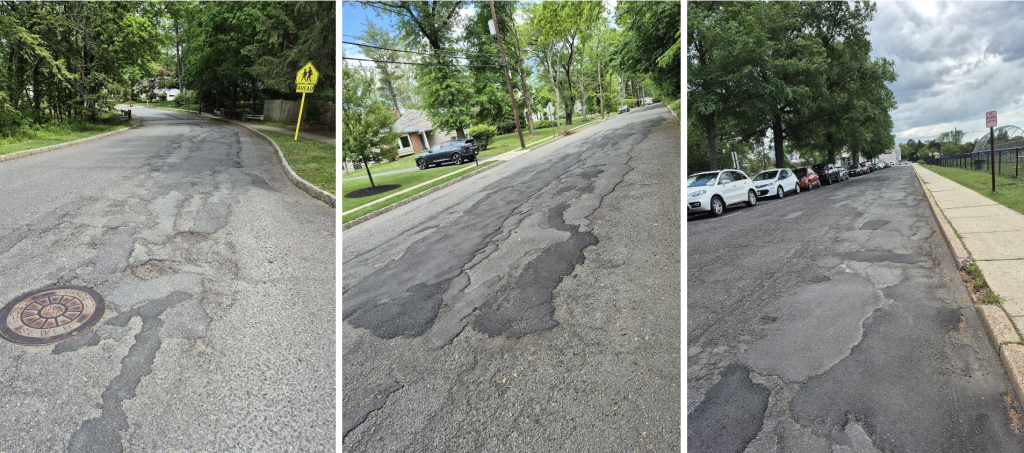
Pretty Brook Rd is hardly even a contender for the worst road in Princeton. That award should probably go to the stretch of Franklin Ave between Walnut Ln and Linden Ln. Or perhaps Littlebrook Rd, or maybe Overbrook Dr/Shadybrook Ln… you get the point. There are so many roads in such terrible shape in Princeton that bikers are forced to carefully pick lines as if descending treacherous goat paths on a mountain bike. In fact, I do actually ride a gravel bike with cushiony, 1.75 inch wide tires. I can’t imagine what it is like for folks on skinny commuter or road bike tires.
And you know what the kicker is? Many of these roads, many of the worst road surfaces in Princeton, are on so-called “Bike Boulevards” where, in principle, the road is meant to be optimized for bike safety. These roads are not safe. To a driver, potholes might mean an expensive repair. To a person on a bike, as we have sadly just seen, it can mean life or death.
So what can be done? One solution is to use the “see click fix” function for reporting potholes ( https://seeclickfix.com/princeton_nj). This is a great first step and I encourage everyone to make use of this when they see issues while out and about walking, biking, or driving. But the unfortunate reality is that many of the roads have deteriorated beyond what is fixable with these sorts of stop-gap measures.
The real solution is preventative maintenance and resurfacing, proactively led by the city itself. It should not be incumbent upon Princeton’s community members to survey the state of its roads and report issues when the roads have deteriorated so far as to be pockmarked by life-endangering potholes. I hope they step up before something like this happens again.
This post by Benjamin Cochrane, Walk Bike Princeton trustee